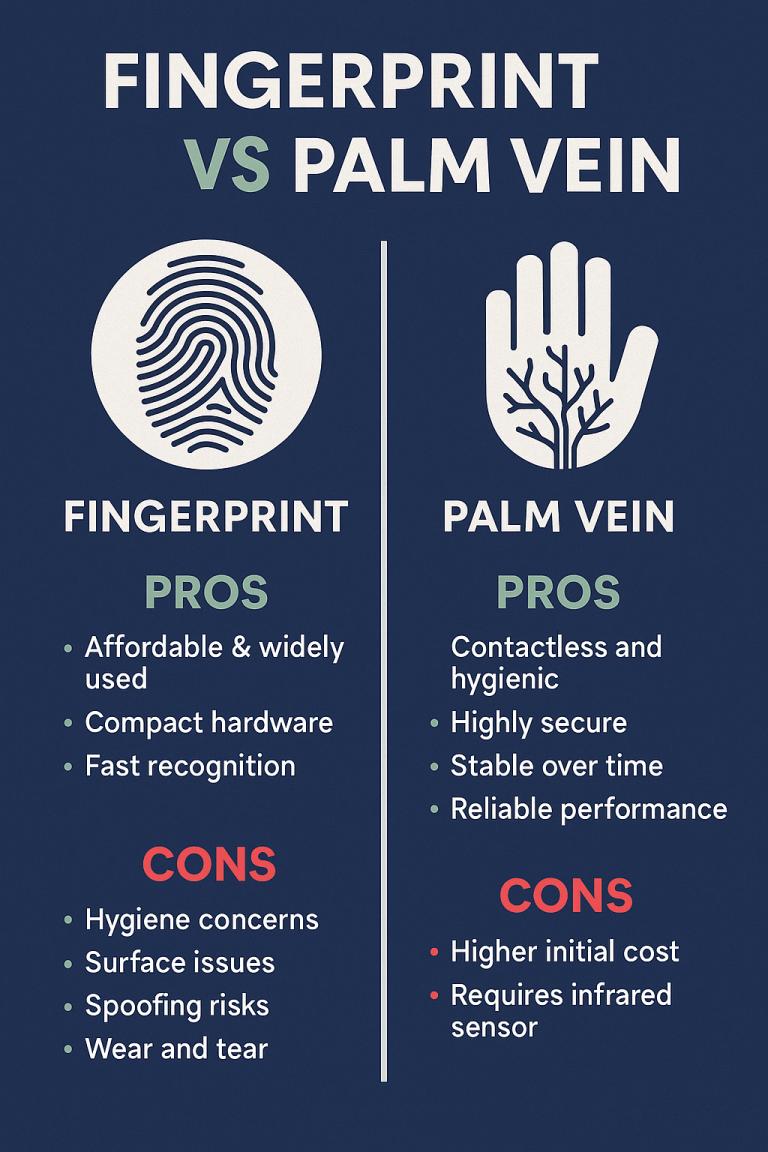
In the world of biometric authentication, two technologies often lead the discussion: Fingerprint Recognition and Palm Vein Recognition. Both have revolutionised how organisations secure access, verify identity, and improve operational efficiency — but they are not created equal.
But here’s the most important point. If you want to implement biometrics to improve efficiency and productivity in your business without compromising your bottom line, talk to a leading expert here.
Let’s explore their key differences, advantages, and limitations, and see why Palm Vein Technology is fast becoming the smarter, safer choice.
🔍 Understanding the Two Technologies
Fingerprint Recognition works by scanning the ridges and valleys on a person’s fingertip. These unique patterns are converted into digital templates used for authentication.
Palm Vein Recognition, on the other hand, goes beneath the skin. It uses near-infrared light to map the unique vein patterns inside the palm — an internal, invisible biometric that is virtually impossible to replicate.
✅ Fingerprint Technology — Pros and Cons
Pros:
Affordable & Widely Used: Fingerprint sensors are low-cost and integrated into many devices.
Compact Hardware: Small sensors make it easy to embed in phones, tablets, and POS terminals.
Fast Recognition: Fingerprint scans are typically quick, often within a second.
Cons:
Hygiene Concerns: Requires physical touch — not ideal in healthcare, food service, or public environments.
Surface Issues: Sweat, dust, or damaged skin can reduce accuracy.
Spoofing Risks: Fingerprint patterns can be lifted or copied from surfaces, creating security vulnerabilities.
Wear and Tear: Sensors degrade over time with heavy use, affecting reliability.
💡 Palm Vein Technology — Pros and Cons
Pros:
Contactless and Hygienic: Users simply hover their palm above the scanner — perfect for hospitals, offices, and payment terminals.
Highly Secure: Vein patterns are internal and can’t be forged or copied. Even identical twins have completely different vein structures.
Stable Over Time: Vein patterns remain unchanged throughout a person’s life.
Reliable Performance: Works regardless of surface conditions like dirt, moisture, or skin damage.
Inclusive: Works for people with worn fingerprints (e.g., elderly, construction workers, medical staff).
Cons:
Higher Initial Cost: Palm vein sensors are more sophisticated and slightly more expensive.
Requires Infrared Sensor: Needs a certified optical system, not a simple camera.
🚀 Why Palm Vein Leads the Future
In a world increasingly focused on data security, hygiene, and user experience, Palm Vein technology offers a future-proof solution. It’s not just a step ahead — it’s a leap forward.
That’s why forward-thinking organisations are adopting Palm Vein Scanners for applications in:
Healthcare — contactless staff and patient verification
Financial and Banking — secure and fraud-free authentication
Education and Access Control — hygienic attendance systems
Retail and Payments — fast, touch-free checkout experiences
🟣 The Verdict
While fingerprint technology has served well for years, Palm Vein Recognition is redefining what secure identity means.
It’s cleaner, smarter, and safer — designed for a world that values both security and trust.
As technology evolves, Palm Vein isn’t just the next generation of biometrics — it’s the benchmark for the future.